

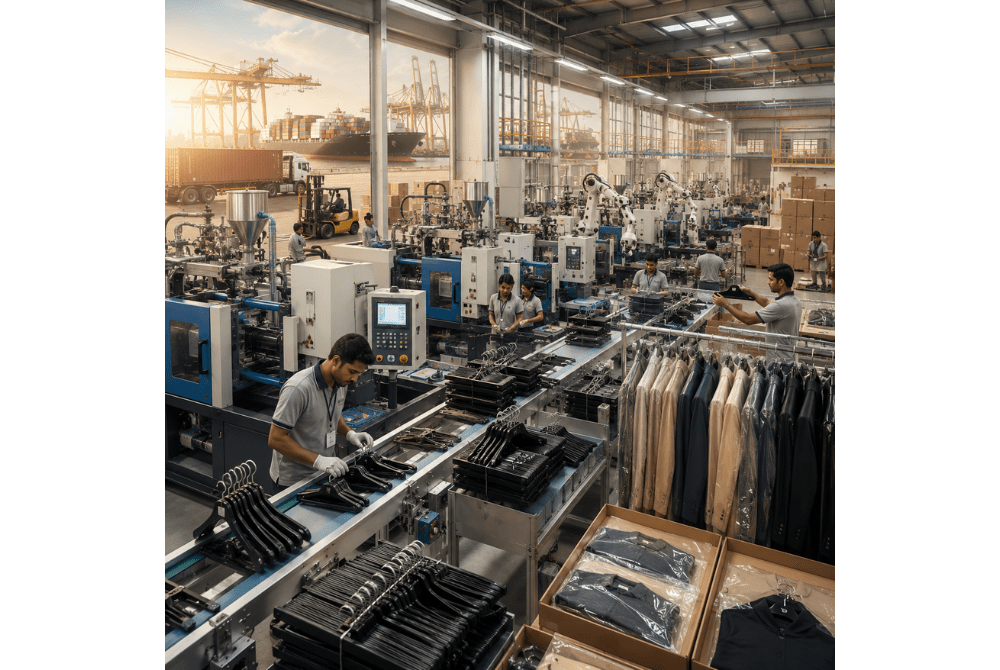
Bangladesh’s rapidly growing garment export industry is attracting fresh investment into supporting industries, with a new hanger manufacturing venture aiming to secure a major share of the country’s $400 million apparel hanger market. Global hanger manufacturer Tam Hangers has officially launched its Bangladesh operation in partnership with Meghna Group, bringing international manufacturing standards and advanced technology to the local market.
The joint venture has already invested around $10 million in its initial phase at Meghna Group’s industrial park in Mirzapur, Tangail. The companies now plan to increase total investment to $40 million over the next five years. According to Meghna Group Chairman Mohammad Mizanur Rahman Bhuiyan, the project is expected to install more than 100 injection moulding machines and generate employment opportunities for around 3,000 to 4,000 people at full capacity.
Read More: Bangladesh’s Orange Economy Grows 237%
Industry leaders believe the project will strengthen Bangladesh’s backward linkage industries, especially as every exported garment, particularly premium products for European and American markets, requires quality hangers. At present, a large portion of these products are either imported or supplied by smaller local manufacturers. Through this partnership, the companies aim to reduce import dependency while improving product quality and manufacturing efficiency.
The venture also plans to achieve an annual turnover of $200 million within the next five to seven years and capture at least half of Bangladesh’s domestic garment hanger market. Tam Hangers currently supplies global fashion brands such as H&M and Marks & Spencer, positioning the Bangladesh operation to become an important part of the international apparel supply chain.
However, the project has also highlighted ongoing concerns among foreign investors regarding bureaucratic barriers in Bangladesh. Tam Hangers Chairman Gokhan Tezsezer stated that despite four years of efforts, the company could not obtain approval for a hanger recycling and reuse facility in Bangladesh and was eventually forced to move the project to Sri Lanka. He noted that such a facility could have created thousands of additional jobs while supporting sustainable and circular manufacturing practices.
Read More: Factories Set for Private Revival as 50 Idle Units to Drive Economic Growth
As Bangladesh continues to strengthen its position as a global apparel manufacturing hub, investments in supporting industries like packaging, accessories and hanger manufacturing are becoming increasingly important. Industry observers believe that smoother regulatory processes and stronger policy support could help the country attract even larger foreign investments in sustainable manufacturing and circular economy initiatives in the coming years.