

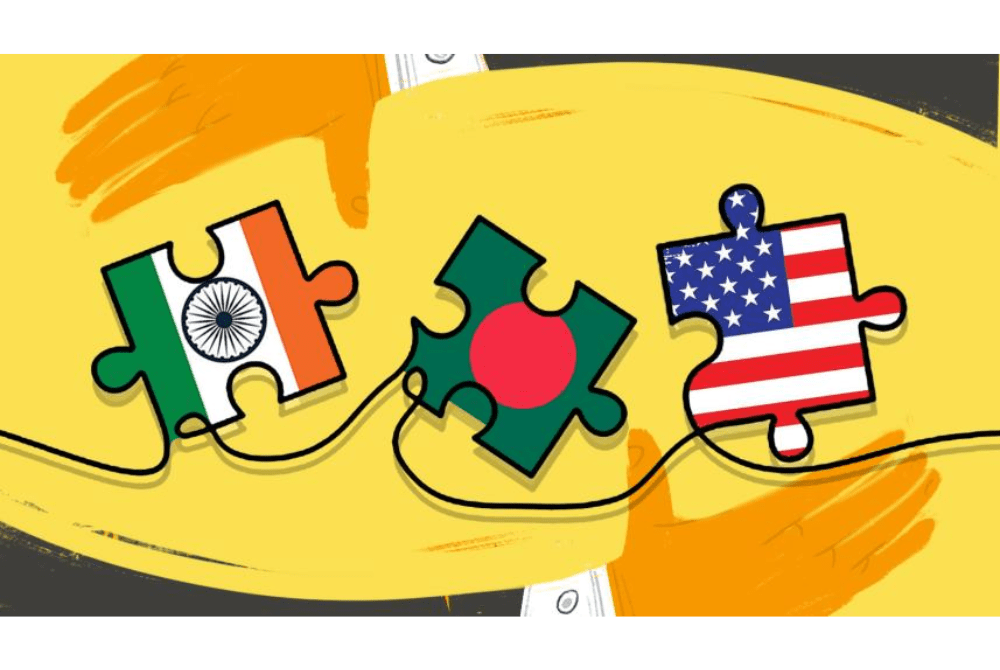
Bangladesh’s trade landscape saw a notable shift in January as the United States moved ahead of India to become the country’s second largest trading partner. While China continues to dominate overall trade, this change reflects evolving import patterns and a growing economic connection between Bangladesh and the US.
According to the latest data, Bangladesh’s total trade with the United States reached Tk 146.86 billion, equivalent to approximately $1.2 billion, accounting for 9.28% of the country’s total trade. In comparison, India’s trade stood at Tk 125.08 billion or around $1.02 billion, representing 7.91%. China maintained its leading position with a trade volume of Tk 281.94 billion, or about $2.3 billion, capturing 17.82% of Bangladesh’s total trade.
Read More: Bangladesh Secures $1.9B Global Financing to Strengthen Economy
For years, India had consistently held the position of Bangladesh’s second largest trading partner. However, the January figures indicate a temporary reshuffling, with the US moving into second place. Analysts caution that this change may not yet represent a long term shift, as trade volumes between India and the US remain closely matched.
Experts attribute this rise in US trade primarily to increasing imports. Zaidi Sattar, Chairman of the Policy Research Institute of Bangladesh, noted that Bangladesh’s imports from the US have been steadily increasing. He highlighted that growing demand for liquefied petroleum gas and other commodities has played a key role in this trend. There is also significant potential to expand imports further, particularly in sectors such as energy and cotton.
A major development influencing future trade is a new US cotton policy introduced in 2025. Under this policy, countries that use US origin cotton in their manufacturing processes can benefit from zero tariff access when exporting finished goods to the US market. This could create a strategic opportunity for Bangladesh’s export oriented garment industry. For instance, importing cotton worth $1 billion from the US could potentially unlock duty free export opportunities of an equivalent value.
Another factor highlighted by experts is the quality difference in cotton sourcing. US cotton is typically machine picked, which ensures greater consistency, while cotton from countries like India and Pakistan is largely hand picked.
Read More: Govt Prioritises Long-Term Growth Over Immediate Tax Relief
Masrur Reaz, Chairman and CEO of Policy Exchange Bangladesh, described the development as encouraging. He emphasized that stronger trade ties with a Western economy like the US indicate a gradual diversification of Bangladesh’s import sources. At the same time, he pointed out the importance of maintaining and strengthening trade relationships within South Asia, particularly with India, Pakistan, and Sri Lanka.
Overall, the shift signals a changing dynamic in Bangladesh’s trade ecosystem. While China remains firmly at the top, the growing role of the United States highlights new opportunities for diversification, strategic sourcing, and potential export advantages. However, whether this change becomes a sustained trend will depend on future trade patterns, policy impacts, and the balance of imports between competing partners.