

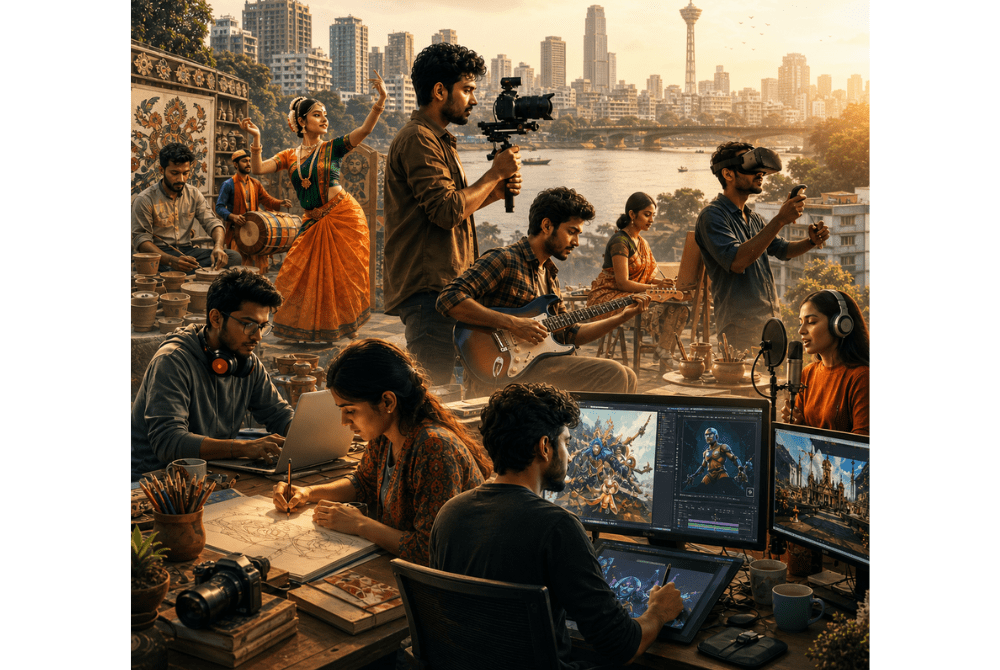
Bangladesh’s orange economy is growing rapidly, even without a dedicated national policy framework. According to the latest Economic Census 2024 by the Bangladesh Bureau of Statistics (BBS), employment in the Arts, Entertainment and Recreation sector reached 1,12,829 people in 2024, marking a remarkable 237% increase from 33,441 jobs in 2013. The growth reflects rising demand for creative work, the expansion of digital platforms and the increasing role of freelancers across sectors such as media, design, music, gaming, fashion and content creation.
Read More: Factories Set for Private Revival as 50 Idle Units to Drive Economic Growth
The sector also made a significant economic contribution in FY25, adding Tk9,193 crore to Bangladesh’s GDP. This represents a 15.4% year on year growth rate, which is higher than the country’s overall nominal GDP growth of 10.2%. Data from BBS show that the orange economy is now expanding faster than agriculture, industry and services, although its total contribution still stands at only 0.17% of the Tk55 lakh crore economy.
Despite this momentum, the sector continues to face major structural challenges. Bangladesh still lacks a dedicated policy for the creative economy, and public investment remains very limited. In FY26, the combined development allocation for the cultural affairs ministry, information and broadcasting ministry and youth and sports ministry stood at Tk1,982 crore, which is only 0.81% of the national development budget.
Economists and industry experts believe that the country’s creative workforce remains largely informal and financially insecure. Many artists, musicians and creators struggle with unstable incomes, limited professional protection and the absence of pension or social safety benefits. Experts are now calling for a national policy framework that formally recognizes creative industries as economic contributors rather than only cultural activities.
Read More: US Surpasses India as Bangladesh’s Second Largest Trade Partner
Globally, the orange economy has become a major growth engine, contributing between 0.5% and 7.3% of GDP in different countries, according to UN Trade and Development (UNCTAD). Countries like India are already investing heavily in animation, gaming, digital content and creator-focused education programs through dedicated policy initiatives.
Bangladesh’s government has also started showing interest in the sector. The ruling BNP has pledged to increase the creative economy’s contribution to 1.5% of GDP and create five lakh jobs through regional creative hubs, investment support and institutional reforms. Finance Minister Amir Khosru Mahmud Chowdhury recently confirmed that the creative economy will receive recognition in the upcoming national budget, with greater attention being given to rural artisans, sports, culture, theatre, cinema and music industries. As Bangladesh looks for its next major growth engine beyond traditional sectors, the orange economy is increasingly emerging as a promising opportunity driven by youth, creativity and digital transformation.