

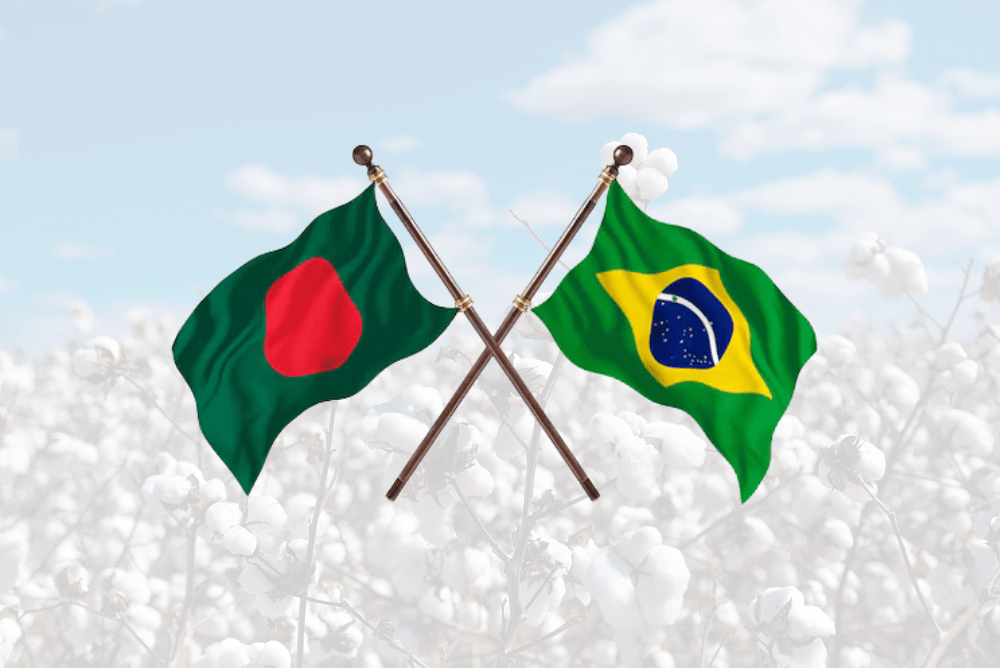
Brazil has become the largest supplier of raw cotton to Bangladesh, overtaking India, according to a new report from the United States Department of Agriculture (USDA). Bangladesh, one of the world’s biggest cotton importers and the second largest exporter of readymade garments, imported a total of 8.28 million bales of cotton in the 2024 to 25 marketing year. Of this amount, Brazil supplied about 1.9 million bales, making up 23 percent of the total.
Read More: UK to continue duty free market access for Bangladesh exports until 2029
India, once the top supplier, ranked second with 1.4 million bales. Other major suppliers included Benin at 1.06 million bales, Cameroon at 616,538 bales, and the United States at 595,902 bales. The USDA report noted that Brazilian cotton has gained popularity among Bangladeshi spinners because of its competitive prices, steady supply, and good availability during harvest periods.
In the previous year, MY24, India held the top position with 1.79 million bales, also accounting for 23 percent of Bangladesh cotton imports. Bangladeshi buyers preferred Indian cotton largely because it reached local mills faster through Kolkata and Benapole, although it was more expensive and sometimes faced quality concerns.
Looking ahead, the USDA forecasts Bangladesh cotton imports to rise to 8.4 million bales in MY26, an increase of 1.4 percent from the current year. This projection reflects expected higher demand from local spinning mills. Compared to MY24, imports in MY26 would be 5.2 percent higher than the 7.8 million bales imported that year.
The report said cotton imports remained stable in MY25 despite early disruptions in the garment sector following the formation of a new interim government in August 2024, after former prime minister Sheikh Hasina left the country amid a student led movement.
Domestic cotton production, however, remains very low. Bangladesh produces only 153,000 bales annually due to limited farmland and long cultivation periods. Cotton is grown on just 45,000 to 46,000 hectares of land. This is far below the needs of the textile industry, which has the capacity to consume about 15 million bales each year depending on power supply, raw material availability, and overall yarn demand.
In MY25, consumption is estimated at 8.3 million bales, and this is expected to rise to 8.5 million bales in MY26, a 2.4 percent increase. Yarn production is also projected to grow from 1.7 million tonnes in MY25 to 1.9 million tonnes in MY26. Despite rising imports of raw cotton, Bangladesh is still expected to import large volumes of yarn and fabric to support its garment exports. India remains the biggest supplier of cotton yarn due to its large spinning industry and lower logistics costs. China continues to be the top exporter of fabric to Bangladesh, followed by Pakistan and India.