

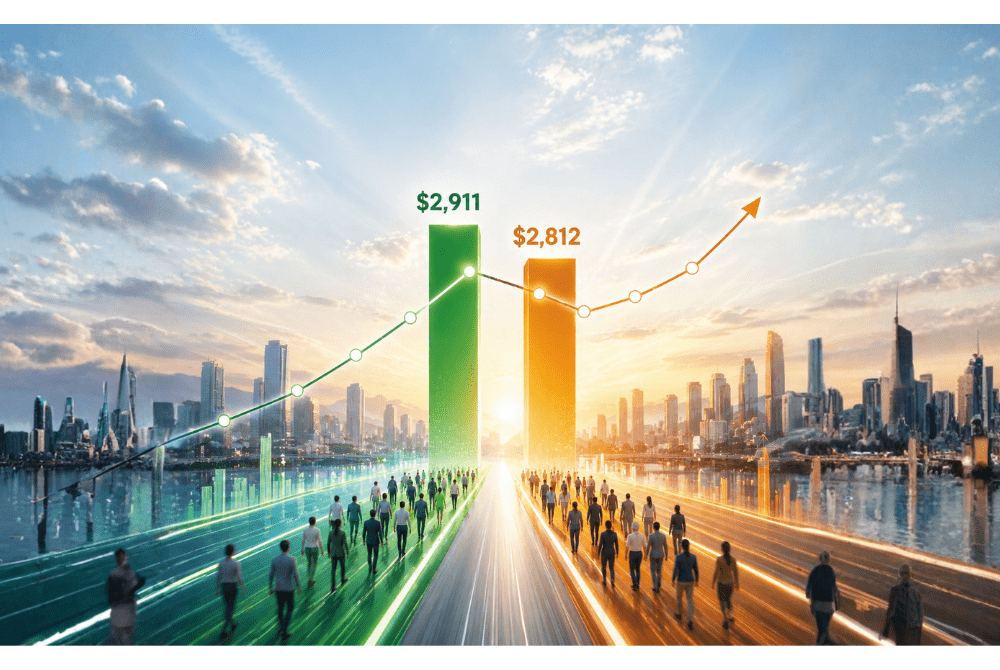
The latest update from the International Monetary Fund World Economic Outlook has sparked widespread discussion across South Asia. According to the April release, Bangladesh is projected to surpass India in per capita GDP in 2026 when measured in current US dollars. The forecast places Bangladesh at $2,911 per person, slightly ahead of India’s $2,812. While the numerical gap is modest, the development carries strong symbolic value given the scale difference between the two economies.
Read More: Singer Bangladesh revenue rises to Tk 5.8B
India’s economy, estimated at $3,916 billion in 2025, is nearly eight times larger than Bangladesh’s $458 billion. Despite this, per capita GDP focuses on average income per person rather than total economic size, allowing smaller economies to occasionally move ahead. This is not an isolated event. Bangladesh maintained a higher per capita GDP than India from 2018 to 2024 and had also led during the period between 1989 and 2002. These recurring shifts highlight how dynamic this metric can be over time.
A major factor behind these fluctuations is currency movement. Per capita GDP in current dollars depends on exchange rates, meaning any depreciation in local currency reduces the dollar value of income. Both the Bangladeshi taka and the Indian rupee have experienced depreciation in recent years, but not at the same pace. This difference in currency performance plays a critical role in shaping short term comparisons, even when underlying economic productivity remains relatively stable.
Read More: Remittance fuels economic prosperity, shaping Bangladesh’s future
However, when the analysis moves beyond nominal figures, a different picture emerges. The IMF also evaluates income using purchasing power parity, which adjusts for cost of living and reflects what people can actually buy within their own country. On this basis, India continues to maintain a clear lead. In 2025, India’s PPP adjusted per capita GDP stands at $11,789, around 15 percent higher than Bangladesh’s $10,271. The gap is expected to widen further by 2031, with projections placing India at $18,485 and Bangladesh at $14,857.
The expected crossover in 2026 therefore reflects more than just economic growth. It signals that both economies are now operating within a close range in dollar terms, influenced heavily by exchange rate dynamics. At the same time, it reinforces the importance of interpreting economic indicators with context, as nominal comparisons alone do not fully capture living standards or long term economic strength.