

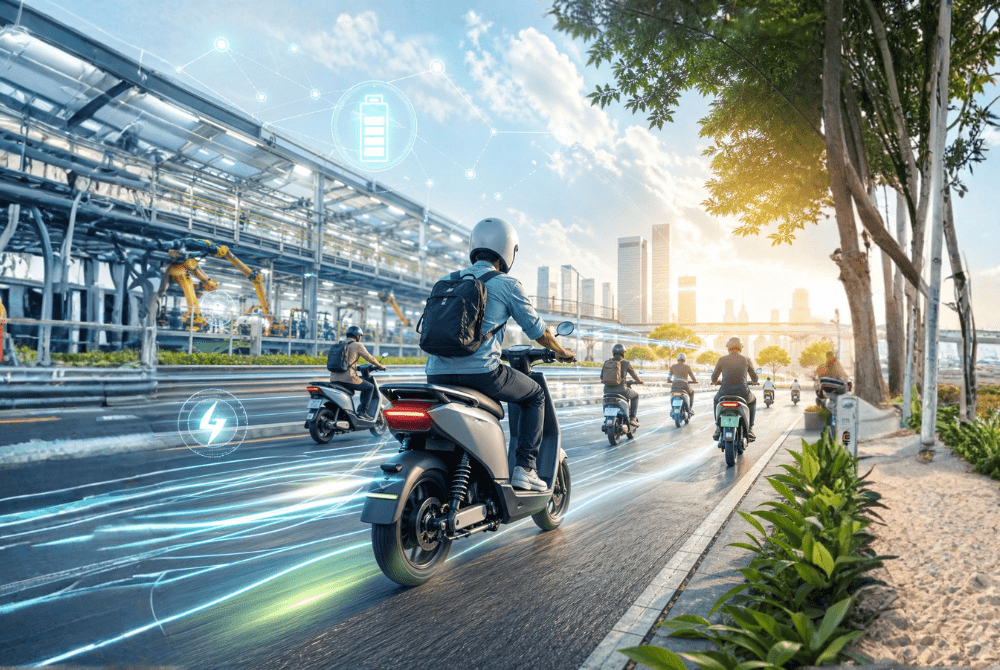
Bangladesh’s mobility landscape is entering a new phase as electric bikes and scooters rapidly move from niche adoption to mainstream growth. Backed by more than Tk2,000 crore in fresh investments, the sector is attracting major industrial players such as Walton, PRAN-RFL Group, Runner Automobiles, Akij Group and Nasir Group, signaling strong long-term confidence in electric mobility.
The surge is largely driven by economic practicality. With fuel prices rising and urban congestion worsening, consumers are shifting toward alternatives that reduce daily costs. Operating an e-bike typically costs only Tk0.30–0.40 per kilometre, compared to Tk2–4 for petrol motorcycles. Over time, this translates into substantial savings, with industry estimates suggesting up to 80 percent reduction in transport expenses for regular users. Combined with lower maintenance requirements and home-charging convenience, e-bikes are becoming an increasingly attractive option for urban commuters.
Read More: Rail Economy Set for Boost with €705 Million EIB Investment
Market growth is clearly reflected in both sales and import trends. Just three years ago, monthly sales were negligible at around 100 units. Today, that figure has climbed into the thousands. According to National Board of Revenue data, imports increased sharply from 2,446 units in FY23 to 10,053 units in FY25. However, the actual market size is believed to be significantly larger, as a substantial volume of CKD and SKD kits used for local assembly is not fully captured in official import statistics.
Local manufacturing and assembly are also gaining momentum. Walton has already established a strong early presence, capturing around 18 percent market share and planning a large-scale factory with an annual production capacity of 20,000 units. PRAN-RFL has entered the segment with its RYDO brand, investing approximately Tk200 crore and targeting a monthly output of 3,000 units at full capacity. Nasir Group has invested Tk300 crore with plans to scale further, while Runner Automobiles is expanding its EV portfolio through partnerships and local assembly. Akij Motors is focusing on the premium segment, reflecting evolving consumer preferences toward higher performance and durability.
Despite this rapid expansion, the sector continues to face structural challenges. Bangladesh remains heavily dependent on imports, particularly from China, with a significant share of components and fully built units sourced from abroad. Infrastructure limitations are also a major constraint. The country currently has only around 112 public charging stations, most of which are concentrated in Dhaka and Chattogram, creating range limitations for users outside major urban centers.
Read More: Northern Airport reopens to Unlock Billions in Economic Growth
Regulatory barriers further complicate adoption. Registration costs ranging between Tk8,000 and Tk12,000, combined with the absence of a streamlined registration system, discourage many potential buyers. Industry stakeholders also point to the lack of a comprehensive policy framework for electric vehicles as a key obstacle to scaling the sector more efficiently.
Even with these challenges, the outlook remains highly promising. Bangladesh’s motorcycle market is already valued at approximately Tk7,000–8,000 crore and continues to grow at an estimated 16–17 percent annually. Within this expanding ecosystem, e-bikes are emerging as a cost-effective and environmentally aligned alternative that aligns with both consumer needs and national sustainability goals.
If supported by improved infrastructure, simplified regulations and continued investment in local manufacturing, e-bikes have the potential to reshape urban mobility in Bangladesh and become one of the country’s next major industrial success stories.