

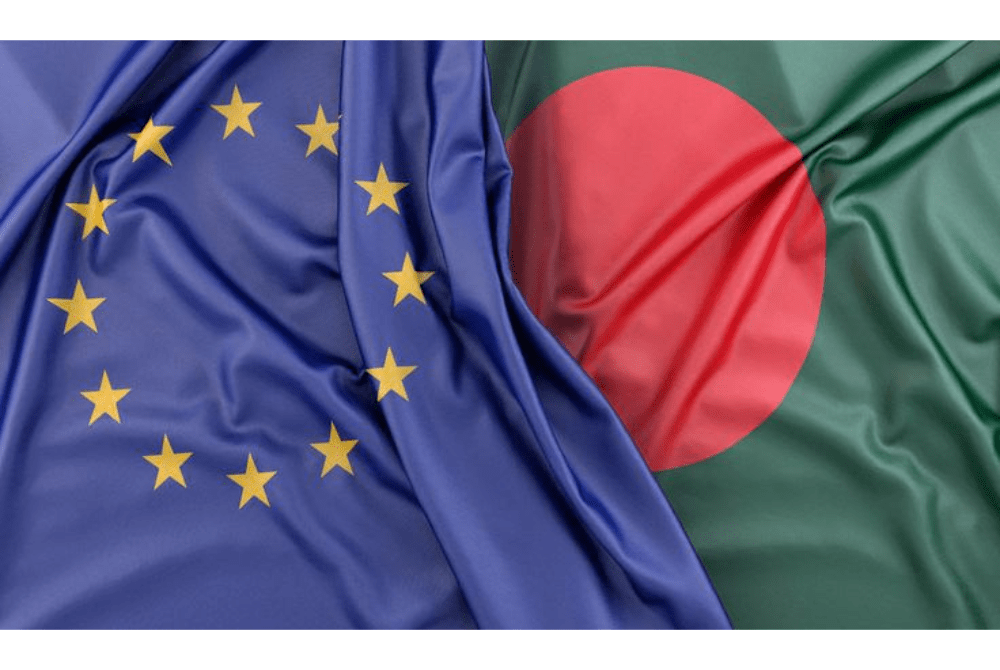
European diplomats and business leaders have urged Bangladesh to increase imports from the European Union to help reduce the EU’s large trade deficit with the country. The call comes as Bangladesh has recently committed to narrowing its trade gap with the United States by purchasing more American goods under a reciprocal tariff agreement.
The message was delivered during a joint dialogue on business climate held at the Bangladesh Investment Development Authority office in Dhaka. EU Ambassador to Bangladesh Michael Miller highlighted that both sides are working toward a mutually beneficial investment partnership, which will depend on disciplined teamwork, a fair playing field and consistent policy implementation.
Read More: Bangladesh’s Exports to the US Rise to 8.69 Billion Dollars in FY25
European representatives noted that Bangladesh’s commitment to buying more US products has strengthened their expectation for similar steps. They argued that imports of European machinery, chemicals and other goods must rise if the current imbalance is to be addressed. In 2024, total EU Bangladesh trade in goods reached 22.2 billion euros, with the EU recording a deficit of 17.5 billion euros. Nearly 94 percent of EU imports from Bangladesh were garments and textiles, while the EU’s main exports to Bangladesh were machinery and appliances at 35 percent and chemicals at 23 percent.
In services, total trade was valued at 2 billion euros in 2023, where the EU held a surplus of 0.8 billion euros. Combined goods and services trade between the two partners totalled 23.9 billion euros that year.
EuroCham Bangladesh Chairperson Nuria Lopez said European businesses share a long term goal of expanding foreign direct investment and addressing the deficit as Bangladesh prepares to graduate from the least developed country group in 2026. She emphasised the need for improvements in customs, logistics, standards, regulatory enforcement and import procedures.
Several European ambassadors echoed similar views. They called for predictable regulation, stronger governance, faster approvals, stable policy environments and clear rules to support investment. They also highlighted opportunities for partnership in areas such as agriculture, water, logistics, ceramics, leather, design and sustainable fashion.
Read More: Bangladesh Enters a New Age of App Banking
Government officials outlined ongoing reforms and infrastructure upgrades. Chittagong Port Authority Chairman Rear Admiral SM Moniruzzaman described efforts to modernise operations through digitalisation, the Bay Terminal and the Laldia project. Bida Executive Chairman Ashik Chowdhury emphasised investor grievance mechanisms, structural reforms and plans to attract more European companies. Special envoy Lutfey Siddiqi stressed the importance of a clear reform roadmap and early engagement with the EU ahead of LDC graduation.
The dialogue reflected a shared understanding that while Bangladesh remains one of Europe’s key export destinations, a more balanced and predictable trading environment will be essential for future growth in trade and investment.